
Currently Empty: $0.00
A person who suddenly collapses, becomes unresponsive, and is not breathing normally needs action right away. AED training gives you a clear, practiced response for that critical moment: call 911, begin CPR, bring the AED, and follow its prompts. You do not need to be a healthcare professional to make a meaningful difference. You need the confidence to recognize cardiac arrest and the skills to act without losing valuable time.
Why AED Training Matters When Cardiac Arrest Happens
An automated external defibrillator, or AED, is designed to analyze a person’s heart rhythm and, when appropriate, deliver an electrical shock that may help restore a life-sustaining rhythm. It does not guess. The device provides voice or visual instructions, analyzes the rhythm, and advises the rescuer whether a shock is recommended.
That simplicity can be misleading. In a real emergency, people may hesitate because they are frightened of doing something wrong, unsure whether the person is truly in cardiac arrest, or concerned about using equipment they have never touched. Training replaces uncertainty with a sequence you can remember under pressure.
Cardiac arrest is not the same as a heart attack, although a heart attack can sometimes lead to cardiac arrest. A person in cardiac arrest is unresponsive and either not breathing or only gasping. Those occasional gasps can be mistaken for normal breathing, which is one reason hands-on instruction matters. The faster CPR and defibrillation begin, the better the person’s chance of survival can be.
An AED is most effective when it is used quickly, alongside high-quality CPR. CPR keeps blood moving to the brain and vital organs. The AED evaluates whether a shockable rhythm is present. These actions work together, and neither should delay the other.
What You Practice in AED Training
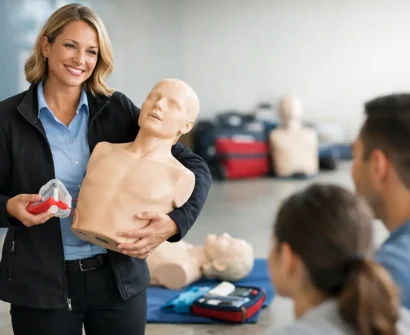
A good course does more than explain where to place pads. It lets participants work through realistic scenarios, handle training equipment, and repeat the response steps until they feel more natural. The goal is not perfection. The goal is to start care promptly, stay focused, and continue until emergency responders take over.
Recognizing the emergency and calling for help
Training begins with scene safety and a quick assessment. You learn to check whether the person responds and whether they are breathing normally. If they are unresponsive and not breathing normally, call 911 or direct a specific bystander to call. If other people are present, send someone for the AED immediately.
Giving direct instructions is a practical skill. Rather than calling out, “Someone get help,” point to a person and say, “You in the blue shirt, call 911. You, bring the AED.” Clear roles reduce confusion and get essential tasks moving at the same time.
Using the AED without unnecessary delays
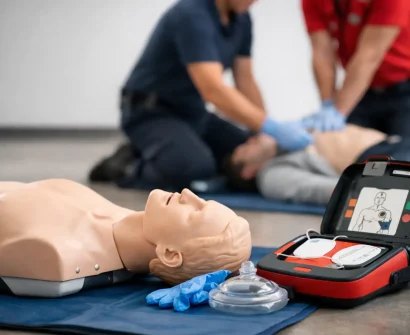
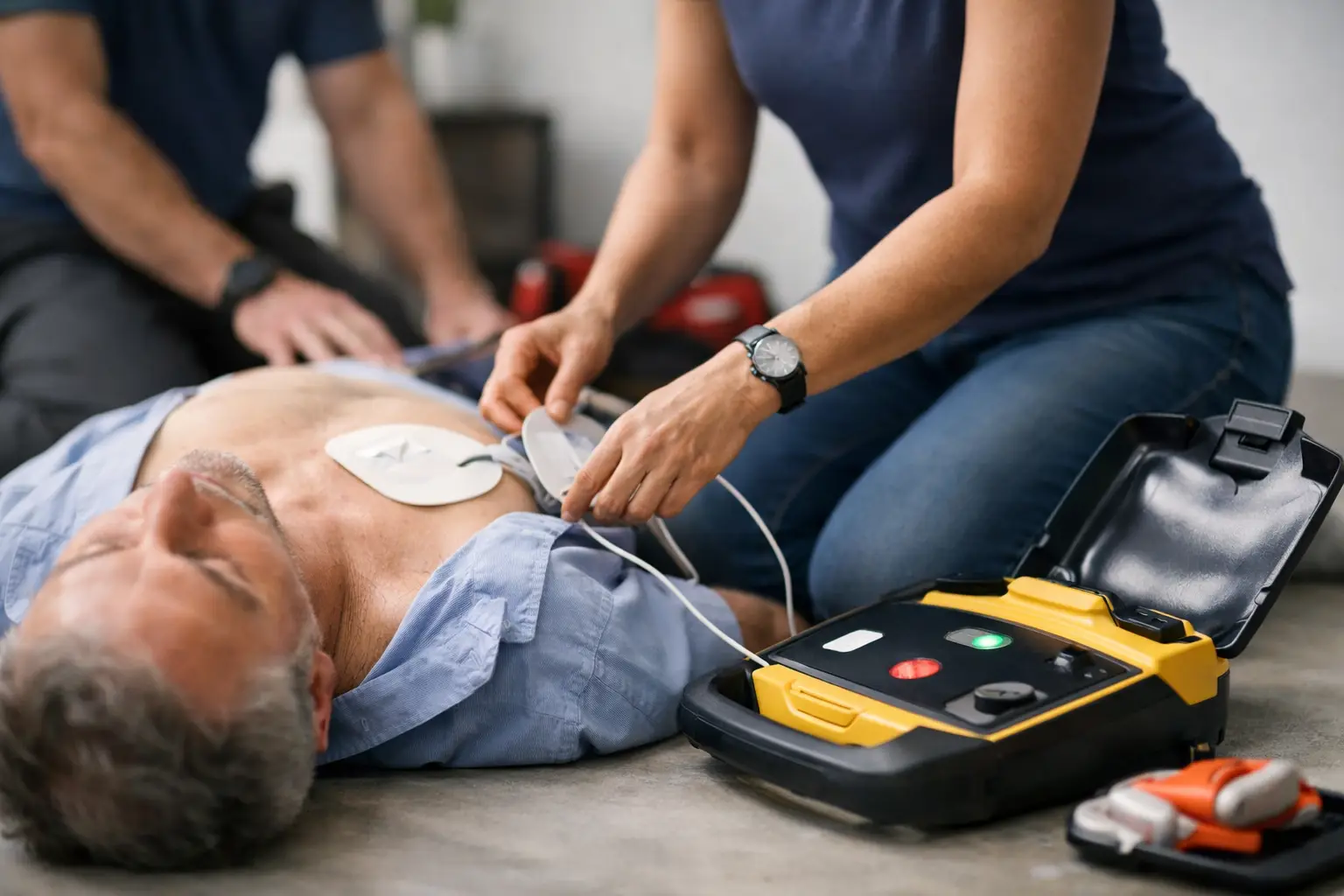
Once the AED arrives, turn it on and follow the prompts. Expose the person’s chest, dry it if it is wet, and attach the pads as shown on the diagrams. The device will tell you when to stop CPR so it can analyze the rhythm. Everyone must stay clear of the person during analysis and, if advised, during shock delivery.
After a shock, or if no shock is advised, resume CPR right away. This is a key point that learners practice repeatedly: pauses in chest compressions should be as brief as possible. The AED will continue to guide the process and reanalyze at intervals.
Training also prepares you for common situations that can cause hesitation. If the chest is very hairy and the pads will not stick, quickly remove enough hair for good pad contact. If there is a medication patch where a pad needs to go, remove the patch and wipe the area. If the person has a pacemaker or implanted device, avoid placing the pad directly over the visible bump. These adjustments should be made quickly, without delaying defibrillation.
Combining CPR and AED skills
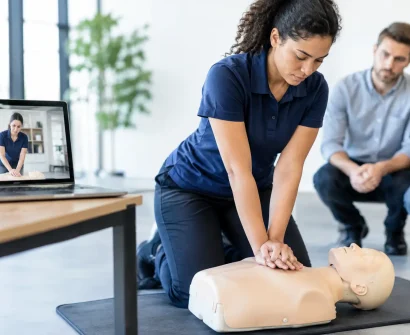
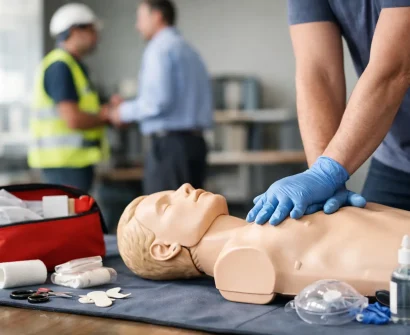
AED training is strongest when paired with CPR instruction. You practice effective chest compressions, rescue breaths when included in your course level, team communication, and quick transitions between compressions and AED use. For workplaces, healthcare settings, schools, and child care environments, these team skills can be just as valuable as knowing how to operate the device itself.
Adult, child, and infant emergencies may require different pad placement or pediatric settings. When pediatric pads or an attenuator are available, use them according to the AED instructions. If they are not available, follow the device prompts and your training. A course gives you the opportunity to ask these questions before an emergency happens.
Choosing the Right AED Training Course
The right course depends on where you may need to respond and whether you need formal certification. A parent, coach, teacher, or community volunteer may benefit from a CPR AED course focused on responding to adults, children, and infants. A workplace team may need training that meets its occupational safety plan and addresses the equipment available on site.
Healthcare professionals often require Basic Life Support certification and more advanced clinical training based on their role. BLS includes a team-based approach to high-quality CPR and AED use, while ACLS and PALS build on those fundamentals for clinicians managing more complex emergencies.
Before registering, consider the people you serve, the requirements of your employer or licensing body, and whether the course includes practical evaluation. Online learning can be a useful way to cover theory and prepare for class, but an AED is a hands-on device. Blended training that includes instructor-led skills practice helps ensure you can apply the information, not simply recall it.
It also helps to confirm what your certification must include. Some organizations require a nationally recognized credential, a specific course provider, or renewal by a certain date. Choosing the correct level from the start avoids the frustration of completing a course that does not meet your requirement.
AED Readiness Is a Workplace Responsibility
Purchasing an AED is an excellent step, but the device alone is not a complete emergency response plan. A workplace should know where its AED is located, who checks it, how often batteries and pads need replacement, and how employees will summon emergency services.
Teams should also discuss what happens after an incident. Someone needs to meet responding paramedics, someone may need to direct bystanders away from the area, and staff may need support after a stressful event. These details are easier to manage when they have been considered in advance.
For schools, fitness facilities, daycares, community centers, and offices, place AEDs where they can be reached quickly and make their location easy to identify. Keep access clear during operating hours. Training should include the people most likely to be nearby when an emergency occurs, not only the person assigned to inspect the unit.
A short practice drill can reveal gaps that are otherwise easy to miss. Is the AED cabinet accessible? Does the team know who calls 911? Can staff find the first aid kit? Is there a backup plan if the trained employee is absent? Preparedness becomes more reliable when it is practiced as a team.
Keep Your Skills Ready to Use
Skills can fade when they are not used. Review the basic response sequence periodically, locate AEDs in the places you spend time, and renew your certification before it expires. If your workplace has an AED, take a moment to look at the model and cabinet so the equipment is familiar before an emergency.
Save a Life First Aid & CPR Training provides practical, instructor-led CPR and AED education for learners throughout Laval and the Greater Montreal region, from first-time responders to healthcare professionals renewing required credentials. The best course is one that matches your responsibilities and gives you meaningful time to practice.
You may never need to use an AED. But if someone collapses at home, at work, in a classroom, or on a sports field, training can help you replace panic with purposeful action. Calling for help, starting CPR, and using the AED promptly are simple steps with extraordinary potential.