
Currently Empty: $0.00
When a patient suddenly loses a pulse, a healthcare team has no time to decide who should lead, who will operate the defibrillator, or when to prepare medications. How ACLS training prepares healthcare teams for cardiac emergencies becomes most visible in those first urgent minutes: it turns critical actions into a coordinated response rather than a collection of individual efforts.
Advanced Cardiac Life Support, or ACLS, is not simply about memorizing a treatment algorithm. It teaches healthcare professionals to recognize life-threatening rhythms, deliver high-quality resuscitation, communicate under pressure, and reassess the patient as the situation changes. For hospitals, clinics, long-term care settings, and emergency response environments, that shared preparation can make a meaningful difference in how confidently and efficiently a team responds.
Cardiac emergencies demand more than individual skill
A cardiac arrest response includes many tasks that must happen nearly at the same time. Chest compressions need to begin quickly and remain effective. Someone needs to attach a monitor or defibrillator, identify the rhythm, establish or manage an airway, obtain access, prepare medications, document events, and communicate with family or other members of the care team when appropriate.
Even highly capable clinicians can lose valuable seconds if those responsibilities are unclear. ACLS training provides a common clinical language and an organized approach. Rather than relying on assumptions, team members learn how to state what they see, confirm what is needed, and close the communication loop. For example, when a team leader gives an instruction, the person receiving it repeats it back and confirms when the task is complete.
This matters because cardiac emergencies are dynamic. A patient may move from ventricular fibrillation to a non-shockable rhythm, regain circulation, or require immediate attention to a reversible cause. Teams need a plan, but they also need the judgment to recognize when the plan must change.
How ACLS training prepares healthcare teams for cardiac emergencies
ACLS education builds on the skills taught in Basic Life Support. Strong CPR, appropriate ventilation, early defibrillation, and rapid recognition of cardiac arrest remain the foundation. ACLS adds the clinical decision-making and team coordination required when the emergency becomes more complex.
Participants learn to assess cardiac rhythms and apply structured treatment pathways for conditions such as ventricular fibrillation, pulseless ventricular tachycardia, asystole, pulseless electrical activity, symptomatic bradycardia, and tachycardia with a pulse. The goal is not to make every situation look identical. The goal is to help clinicians recognize patterns, act within their role and scope, and continue evaluating the patient’s response.
Faster rhythm recognition supports better decisions
In a cardiac arrest, rhythm identification guides the next action. Is the rhythm shockable? Is defibrillation indicated? Should the team continue CPR while preparing medication? A clear answer prevents delays and reduces unnecessary interruptions in compressions.
ACLS training gives clinicians repeated practice connecting monitor findings to the appropriate response. It also reinforces the importance of minimizing pauses before and after a shock. Defibrillation is critical for certain rhythms, but it works best as part of a well-coordinated resuscitation effort that protects the quality of CPR.
Teams practice the rhythm of a resuscitation effort
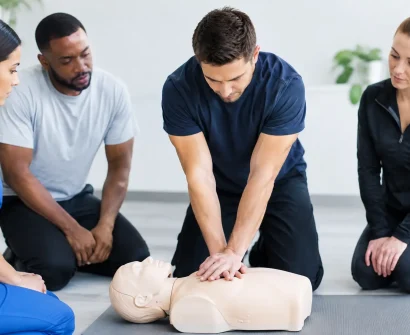
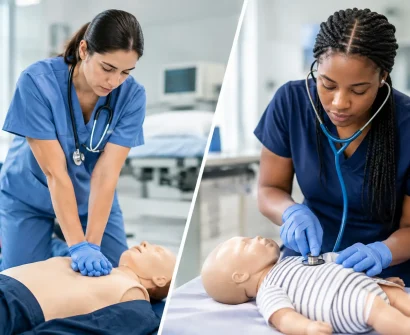
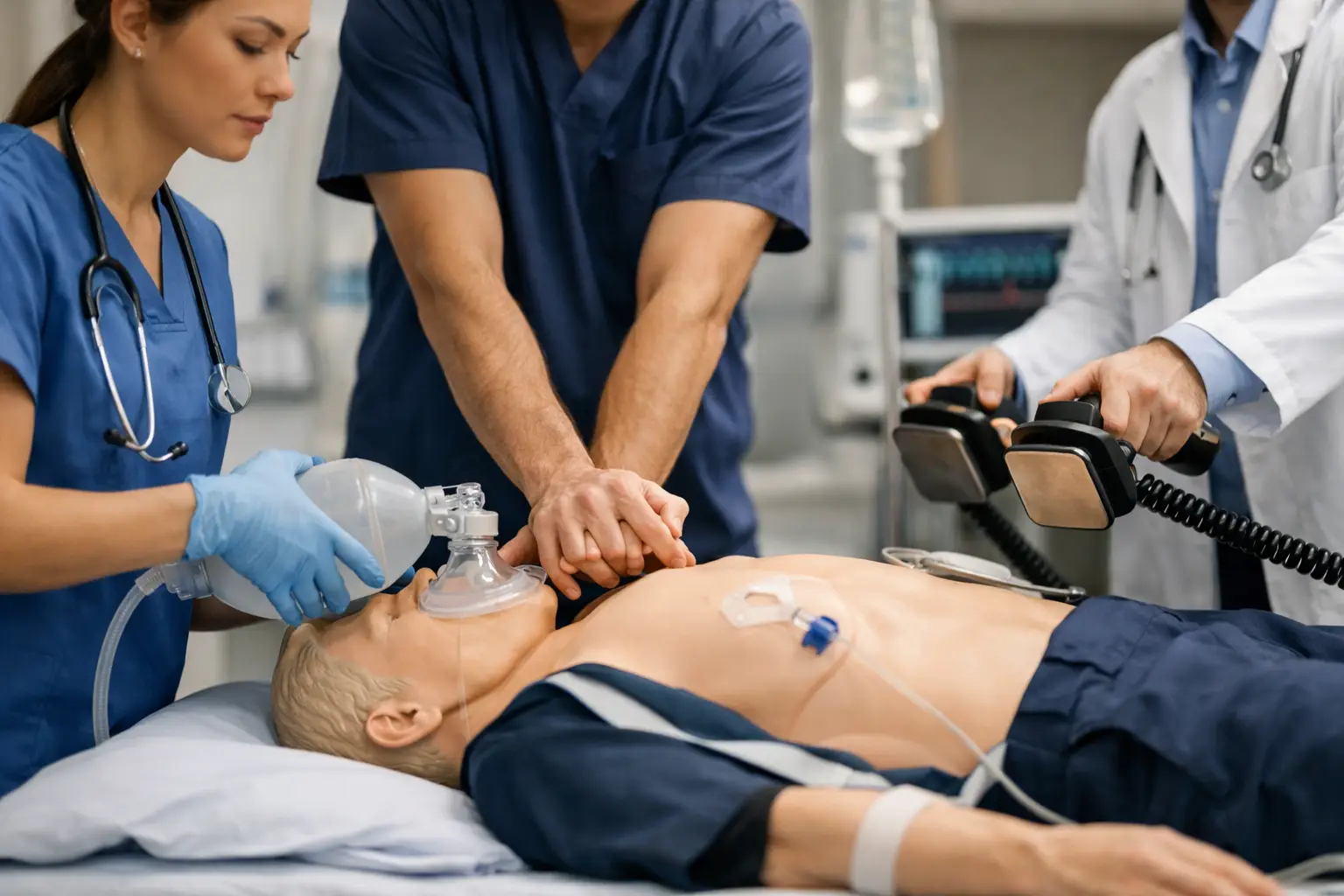
Effective code responses have a deliberate rhythm. While one person delivers compressions, another prepares the defibrillator. A team leader watches time, confirms interventions, anticipates the next step, and ensures that everyone remains focused on the patient. Roles may vary by workplace and available staff, but common responsibilities include:
- Team leader, who directs care and keeps the response organized
- Compressor, who provides consistent, high-quality chest compressions and changes out when fatigued
- Airway provider, who manages ventilation and advanced airway support when indicated
- Defibrillator or monitor operator, who assists with rhythm analysis and shock delivery
- Medication and documentation support, who tracks treatments, times, and the patient’s response
Training helps people move into these roles without waiting for a perfect assignment. It also teaches teams to speak up when they notice a concern, such as shallow compressions, a missed medication time, or an unsafe pause in patient care. Respectful, direct communication is a clinical safety skill.
Reversible causes keep the team thinking beyond the monitor
An ACLS algorithm provides structure, but it does not replace clinical reasoning. During resuscitation, teams are trained to consider reversible causes that may be contributing to the arrest. Depending on the patient and setting, this may include low oxygen levels, severe fluid loss, electrolyte abnormalities, hypothermia, tension pneumothorax, cardiac tamponade, toxins, pulmonary embolism, or coronary thrombosis.
The right response depends on the circumstances. A witnessed arrest in a monitored clinical setting may unfold differently from a patient found unresponsive after an unknown downtime. ACLS training helps teams avoid tunnel vision by pairing protocol-based care with ongoing assessment and relevant patient history.
Simulation turns knowledge into usable performance
Reading an algorithm and leading a code are very different experiences. In a real emergency, alarms sound, equipment may be unfamiliar, family members may be nearby, and several people may speak at once. Stress can affect recall, communication, and fine motor skills.
Hands-on ACLS practice creates a safer place to work through that pressure. Learners rehearse chest compression quality, rhythm recognition, defibrillator use, medication preparation, airway decisions, and role assignment. They can make mistakes, receive feedback, and repeat the scenario before a patient’s life depends on the response.
Simulation is especially valuable for teams that do not manage cardiac arrests every day. A dental office, outpatient clinic, long-term care home, or specialty practice may have a different response system than an emergency department. Training allows staff to identify practical gaps, such as where emergency equipment is stored, who calls emergency services, or how the team will direct responders to the patient.
ACLS also prepares teams for care after return of circulation
A pulse returning is a major milestone, but it is not the end of the emergency. Post-cardiac arrest care requires careful attention to airway and breathing, oxygenation, blood pressure, temperature, blood glucose, possible cardiac causes, and the patient’s neurologic status.
ACLS training introduces the priorities that follow return of spontaneous circulation. Teams learn to stabilize the patient, obtain appropriate information, communicate an organized handoff, and prepare for the next level of care. This continuity matters because a patient who initially improves can deteriorate again without close assessment and timely intervention.
The precise procedures will depend on the clinical environment, local policies, available resources, and each professional’s scope of practice. ACLS does not eliminate the need for workplace protocols or physician direction. Instead, it gives the team a shared framework for acting promptly while following those requirements.
Certification is only one part of readiness
An ACLS course can build confidence, but confidence should be supported by continued practice. Skills can fade when they are not used, particularly in settings where serious cardiac events are uncommon. Regular review of emergency carts, defibrillator procedures, communication roles, and escalation plans helps turn certification into sustained preparedness.
Healthcare organizations can strengthen readiness by scheduling brief mock codes, checking equipment before it is needed, and discussing what went well after drills or real events. These conversations should be constructive. The purpose is not to assign blame. It is to help the next response run more safely and effectively.
For professionals in Laval and the Greater Montreal area, Save a Life First Aid & CPR Training offers practical, instructor-led learning designed to help participants apply ACLS concepts with greater confidence. The most suitable course format may depend on whether someone is earning certification for the first time, renewing credentials, or preparing for a specific workplace role.
Before the next shift, take a few minutes to consider one practical question: if a patient arrested where you work, would every team member know the first action to take? Building that clarity before an emergency is one of the most valuable ways a healthcare team can protect lives.