
Currently Empty: $0.00

A child who suddenly becomes unresponsive creates a moment no caregiver can fully rehearse at home. Pediatric CPR for caregivers provides a clear response when that moment arrives: recognize that the child needs help, activate emergency services, start effective CPR, and use an AED as soon as one is available. The goal is not perfection. It is to keep oxygenated blood moving until emergency professionals take over.
Why Pediatric CPR Is Different
Children are not simply small adults. In adults, sudden cardiac arrest is often linked to a heart problem. For infants and children, cardiac arrest more commonly follows a breathing emergency, such as choking, drowning, severe asthma, an allergic reaction, or a serious infection. That is why rescue breaths are a particularly important part of pediatric CPR when a trained responder is able and willing to provide them.
Pediatric CPR generally applies to infants under age 1 and children from age 1 until puberty. For a child who has reached puberty, use adult CPR techniques. Age and body size can be difficult to judge in an emergency, so focus on the person in front of you and begin care without delaying for an exact classification.
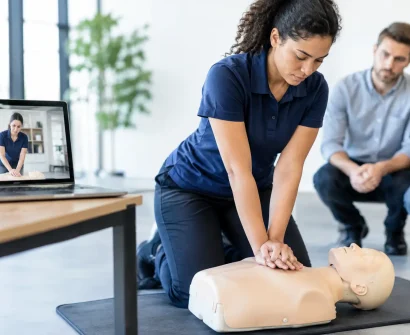
A hands-on course matters because it teaches more than a sequence of steps. Caregivers practice hand placement, compression depth, rescue breaths, AED use, and the decisions that occur when a child is choking, injured, or found underwater. Reading guidance can prepare your mind, but practice prepares your hands.
Recognize When to Start CPR
First, make sure the area is safe for you and the child. Look for traffic, water hazards, smoke, exposed wires, violence, or anything else that could create another victim. Then check whether the child responds. Tap the foot of an infant or gently tap a child and call loudly.
If the child does not respond, look for normal breathing for no more than 10 seconds. Occasional gasping is not normal breathing. If they are not breathing normally, or you are unsure, treat it as an emergency.
Call 911 or direct someone nearby to call and bring an AED. Put the phone on speaker if you are alone so the dispatcher can guide you while your hands remain available. If you are alone with an infant or child and no phone is immediately available, provide about two minutes of CPR before leaving to call 911 and get an AED. The exception is a witnessed sudden collapse: activate 911 and retrieve an AED first if one is close by. These details can vary slightly by setting and local protocol, but calling for help quickly and beginning CPR promptly are always priorities.
Do not spend time searching for a pulse unless you are trained to do so. For most caregivers, an unresponsive child who is not breathing normally needs CPR now.
How to Give Pediatric CPR
For a single caregiver, use cycles of 30 chest compressions and 2 breaths. Aim for a compression rate of 100 to 120 per minute. Let the chest return fully to its normal position after every compression. Complete recoil allows the heart to refill with blood and makes each next compression more effective.
CPR for a Child
Place the heel of one hand in the center of the chest, on the lower half of the breastbone. Use two hands if needed to reach the proper depth without losing control. Compress at least one third the depth of the chest, about 2 inches. Keep your arms straight, press firmly and quickly, and minimize pauses.
After 30 compressions, open the airway with a head tilt and chin lift. Pinch the nose closed, make a seal over the child’s mouth, and give 2 breaths. Each breath should last about one second and produce a visible chest rise. If the chest does not rise, reposition the head and try again. Avoid giving large or forceful breaths.
CPR for an Infant
For an infant, place two fingers in the center of the chest just below the nipple line. Compress about one third the depth of the chest, roughly 1.5 inches. The movement should be smooth, quick, and controlled.
For breaths, cover both the infant’s mouth and nose with your mouth to create a seal. Give 2 gentle breaths, each lasting about one second, only enough to make the chest rise. Infants have small airways and lungs, so excessive force can be harmful.
If two trained rescuers are present, they should use a 15 compressions to 2 breaths ratio. For an infant, the two-thumb encircling hands technique is preferred when two rescuers are providing care. One rescuer should continue CPR while the other calls 911, gets the AED, or prepares it for use.
Use an AED Without Delay
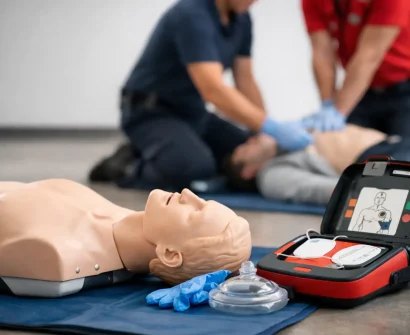
An automated external defibrillator analyzes the heart rhythm and, if appropriate, tells you to deliver a shock. It will not shock a child unless a shockable rhythm is detected. That built-in analysis is why caregivers should not hesitate to turn it on and follow its spoken instructions.
Use pediatric pads or a pediatric setting when available for children and infants. If pediatric pads are not available, use adult pads rather than waiting. Place the pads according to the diagrams on the package. If the pads are too large and might touch, place one pad on the chest and the other on the back.
Keep everyone clear while the AED analyzes the rhythm and when it advises a shock. Immediately resume CPR after a shock is delivered, or after the AED tells you that no shock is advised. Do not pause to check for improvement unless the child begins moving or breathing normally.
When Breaths, Choking, or Drowning Are Involved
Because many pediatric emergencies begin with breathing failure, caregivers should learn how CPR connects with choking and water emergencies. If a conscious child is choking and cannot cough, speak, or breathe, provide age-appropriate choking care. Do not perform blind finger sweeps, as they can push an object farther into the airway.
If the child becomes unresponsive, begin CPR. Each time you open the airway to give breaths, look for a visible object. Remove it only if you can clearly see it. Continue compressions and breaths while another person calls 911 and finds an AED.
After a drowning event, remove the child from the water only when it is safe to do so, call 911, and begin CPR if they are unresponsive and not breathing normally. Do not delay care to try to drain water from the lungs or stomach. Effective breaths and compressions are the urgent priorities.
Avoid Common Delays
Fear of causing harm can stop a caregiver from acting. In a true cardiac arrest, however, the greater danger is doing nothing. Chest compressions may cause injury, but they give a child a chance of survival when the heart has stopped. Start CPR and allow emergency dispatchers and responders to guide the next steps.
Other avoidable delays include moving the child unnecessarily, repeatedly checking for a pulse, giving food or drink, or waiting for someone more experienced to arrive. If a child is unconscious but breathing normally, place them on their side if no spinal injury is suspected and continue monitoring until help arrives. If trauma suggests a neck or spine injury, keep the child as still as possible while maintaining an open airway.
Build Confidence Before an Emergency
Caregivers rarely have the luxury of calm thinking during a crisis. Confidence comes from training before the emergency, not from trying to remember a video or article afterward. A pediatric-focused CPR and first aid course gives parents, grandparents, babysitters, daycare staff, teachers, and coaches an opportunity to practice on realistic manikins, receive instructor feedback, and ask practical questions about the children in their care.
Training should also include choking response, AED practice, recovery position, severe allergic reactions, and bleeding control. The right course depends on your role. A babysitter may need a different level of training than a daycare educator, while healthcare professionals often require pediatric credentials such as PALS or PEARS. Save a Life First Aid & CPR Training offers practical instruction designed to help learners choose training that fits their responsibilities.
Keep emergency contacts visible, know where AEDs are located at school, work, sports facilities, and public spaces, and refresh your skills regularly. When a child needs help, fast action can protect the time that emergency care needs to arrive.