
Currently Empty: $0.00
A person who suddenly collapses, is unresponsive, and is not breathing normally needs immediate action. Knowing how to use an AED can help you respond with purpose while emergency services are on the way. You do not need to be a healthcare professional to use one. AEDs are designed to give clear voice prompts, assess the heart rhythm, and guide a bystander through a potentially life-saving response.
An AED, or automated external defibrillator, is used when sudden cardiac arrest is suspected. It does not restart every stopped heart, and it will not deliver a shock unless it detects a shockable rhythm. Your role is to recognize the emergency, call for help, begin high-quality CPR, and follow the device’s instructions without delay.
Recognize Sudden Cardiac Arrest
Sudden cardiac arrest is not the same as a heart attack, although a heart attack can sometimes lead to cardiac arrest. During cardiac arrest, the heart stops pumping blood effectively. The person may collapse, become unresponsive, gasp, or stop breathing normally.
Agonal gasps can look or sound like breathing, but they are not normal breathing. If an adult or child is unresponsive and not breathing normally, treat it as cardiac arrest. Do not spend valuable time trying to determine the exact cause.
Before approaching, quickly check that the scene is safe. Look for traffic, electrical hazards, fire, violence, or anything else that could put you or others at risk. Once it is safe, tap the person, speak loudly, and check for a response.
Call 911 and Get the AED
Call 911 immediately, or direct a specific person to call. If other people are nearby, point to someone and give a clear instruction: “You in the blue shirt, call 911 and bring the AED.” Specific directions reduce confusion and make it more likely that help arrives quickly.
If you are alone with an adult and have a phone, call 911 on speaker so you can begin care right away. Follow the dispatcher’s instructions. If an AED is close by, retrieve it only if doing so will not significantly delay CPR. In a public setting, AEDs are often located near entrances, reception areas, fitness centers, elevators, or first aid stations.
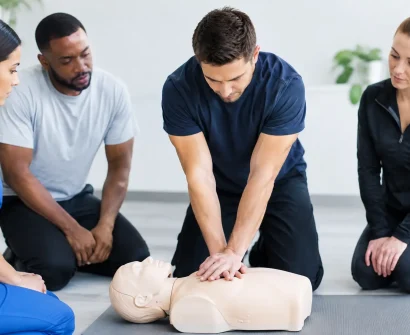
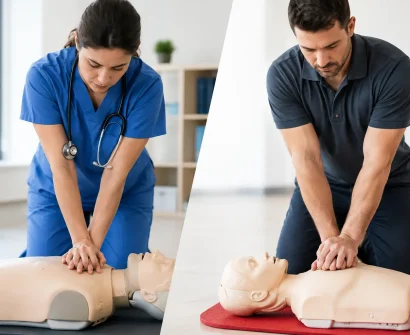
Start CPR as soon as possible. Place the heel of one hand in the center of the chest, place your other hand on top, and push hard and fast at a rate of 100 to 120 compressions per minute. Allow the chest to fully recoil between compressions. If you are trained and willing to provide breaths, use cycles of 30 compressions and 2 breaths. If not, hands-only CPR is far better than doing nothing.
How to Use an AED Step by Step
Turn the AED on immediately
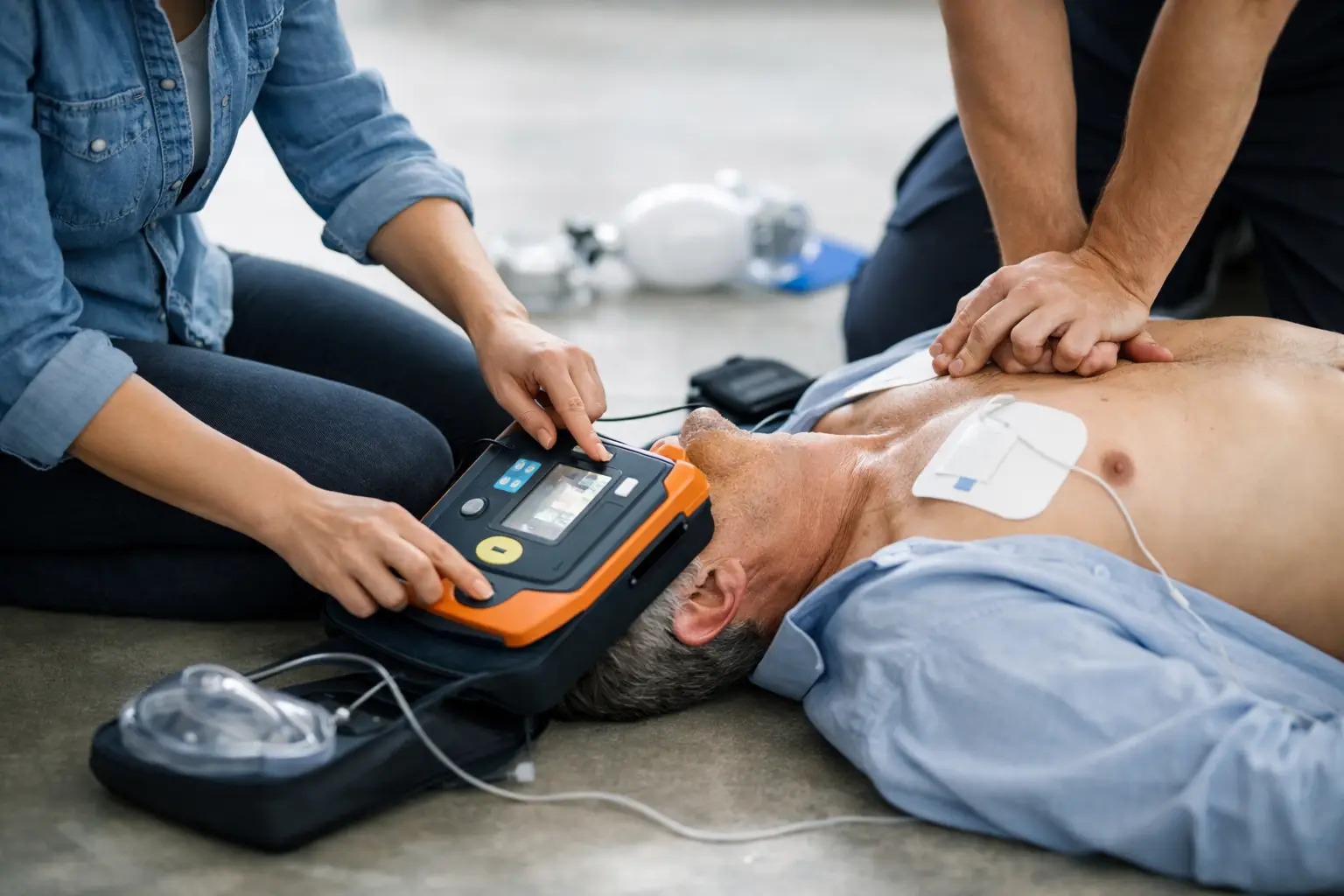
As soon as the AED arrives, place it beside the person’s head or shoulder and turn it on. Some units turn on when you open the lid; others have a clearly marked power button. The device will begin giving voice and visual instructions. Listen carefully and follow each prompt.
Do not wait for CPR to become ineffective or for a trained responder to arrive. Early defibrillation matters because certain cardiac arrest rhythms can be corrected with a shock, especially in the first few minutes.
Expose and prepare the chest
Remove or cut away clothing from the person’s chest. The AED pads must be placed directly on bare, dry skin. If the chest is wet from water, sweat, or rain, quickly dry it with a towel or clothing. A wet chest can prevent the pads from sticking properly.
If the person has a very hairy chest and the pads will not adhere, use the razor included in many AED kits to quickly shave the pad areas. If no razor is available, press the pads firmly onto the chest and proceed. Do not postpone AED use for perfect preparation.
Place the pads as shown
Open the pad package and look at the diagrams. For most adults, place one pad on the upper right side of the bare chest, below the collarbone. Place the second pad on the left side of the chest, several inches below the armpit.
Press each pad firmly so it makes complete contact with the skin. Keep the pad packaging nearby if needed, but do not let it interfere with CPR or the AED cables.
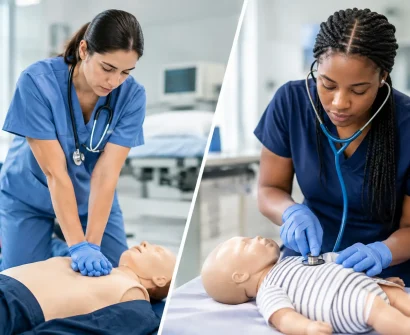
For infants and children, use pediatric pads or a pediatric setting if available and appropriate for the child’s age or weight. Follow the pad illustrations exactly. If pediatric pads are not available, standard adult pads may be used in an emergency, taking care that the pads do not touch each other. One pad may need to go on the chest and one on the back for a smaller child.
Let the AED analyze the rhythm
Once the pads are connected, the AED will tell everyone to stand clear while it analyzes the heart rhythm. Say loudly, “Clear,” and visually check that no one is touching the person, their clothing, or the AED pads.
This pause is essential. Movement can interfere with the analysis. Do not continue chest compressions until the AED tells you to do so.
Deliver a shock only when instructed
If the AED advises a shock, make sure no one is touching the person. Look around again and say, “Clear.” Some AEDs deliver the shock automatically after a warning. Others require you to press a flashing shock button.
Press the button only when directed and only after confirming everyone is clear. The shock may cause the person’s muscles to briefly move. This is expected.
If the AED says, “No shock advised,” that does not mean the emergency is over. It means the device has not detected a rhythm that can be treated with defibrillation at that moment. Resume CPR immediately.
Restart CPR without delay
After a shock, or after the AED advises no shock, begin CPR right away. Do not stop to check for a pulse, look for signs of recovery, or wait to see whether the person wakes up unless they begin moving or breathing normally.
Continue CPR until the AED prompts another analysis, professional responders take over, the person shows clear signs of life, or the scene becomes unsafe. Most AEDs reassess the heart rhythm about every two minutes.
Common Concerns That Should Not Delay You
Many people hesitate because they are afraid of making a mistake. AEDs are built to reduce that uncertainty. The device analyzes the rhythm and will not advise a shock unless it is appropriate.
If the person has a visible pacemaker or implanted defibrillator, you may notice a small lump under the skin near the upper chest. Place the AED pad at least one inch away from the device rather than directly over it. If there is a medication patch where a pad should go, remove the patch with a gloved hand or another barrier, wipe the area clean, and apply the pad.
It is safe to use an AED on a pregnant person when cardiac arrest is suspected. The mother’s survival is the best chance for the baby’s survival. If the person is lying in a puddle or on a wet surface, move them to a drier area if it can be done quickly. Dry the chest, ensure no one is touching the person during analysis or shock delivery, and follow the prompts.
Do not place AED pads over metal jewelry or through clothing. If the person is wearing a bra with underwire, remove it or cut it away so the pads can adhere to bare skin. If a sports bra cannot be removed immediately, cut through it and expose the pad locations.
Why Hands-On Training Still Matters
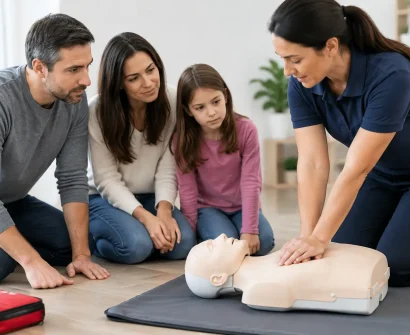
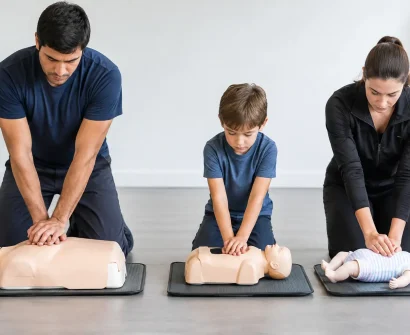
An AED is designed for the public, but reading about the process is not the same as practicing it. In a real emergency, stress can make simple actions feel unfamiliar. CPR and AED training helps you practice chest compressions, pad placement, scene communication, pediatric considerations, and the sequence of care in a calm, supervised setting.
Training also helps you understand what “not breathing normally” looks like and how to work as part of a team. One person can provide compressions while another operates the AED, calls 911, directs bystanders, or prepares for the next cycle of care. These roles can change quickly, especially in workplaces, schools, gyms, and community spaces.
Save a Life First Aid & CPR Training gives participants the opportunity to build those practical skills through instructor-led CPR and AED education. Confidence does not mean feeling fearless. It means recognizing an emergency, taking the next correct step, and continuing until help arrives.
The most useful time to learn an AED is before you need one. Take a CPR and AED course, notice where AEDs are located in the places you spend time, and be ready to act when someone’s life depends on the next few minutes.